Benefits
Events
Products & Programs


Author:
Rohit Kamath
Engineer I – Technical Marketing
Convergent Science
After more than a hundred years, millions of vehicles powered, and billions of kilometers traveled, the diesel engine continues to be a workhorse of the automotive world, especially in high torque applications. However, with tightening emissions regulations and an increasing demand for fuel economy by customers, engine manufacturers face pressure to improve performance while reducing environmental impacts. They need to think outside the box to meet these goals.
Engineers typically approach this challenge by changing a few design variables and evaluating engine performance and emissions. They rely on computational fluid dynamics (CFD) simulations to study the impact of these interconnected variables on combustion, fuel efficiency, and emissions formation, among other factors. Yet, even with modern high-performance computing, exploring the entire design space can still require hundreds of simulations! Identifying an optimal engine practically requires more advanced techniques.
One common strategy is to use response surface methodologies (RSMs), an optimization technique where a mathematical relationship is developed by performing a statistical analysis on a subset of the design space through CFD simulations. This method is computationally inexpensive and can help narrow the design space rapidly. However, these models often fail to capture the highly non-linear interactions in diesel engines, resulting in reduced accuracy in identifying the optimum design.
Another option is to use a genetic algorithm (GA), an evolution-inspired technique in which multiple candidate designs are evaluated using CFD, and the best performing solutions are further modified to generate subsequent generations. This process is particularly effective at exploring a large design space while avoiding local optima, but requires evaluating generations of designs, resulting in a high number of CFD simulations and, hence, lengthy computational times.
While not exhaustive, these methods show the complexities of optimization. Methods that solve the problem reasonably fast may miss the optimal solution, while those that are robust are often computationally expensive. But what if a methodology exists that is both robust and computationally inexpensive?
Machine learning (ML) methodologies have emerged as an appealing option. By learning from a limited set of high-fidelity CFD simulations, an ML model can predict engine performance while ensuring the accuracy of the underlying physics. The result is an optimization process that is both computationally efficient and robust. To demonstrate this, our engineers at Convergent Science conducted a study to optimize a diesel engine using machine learning.
Introduced in late 2024, the ML tool in CONVERGE Studio streamlines optimization problems.
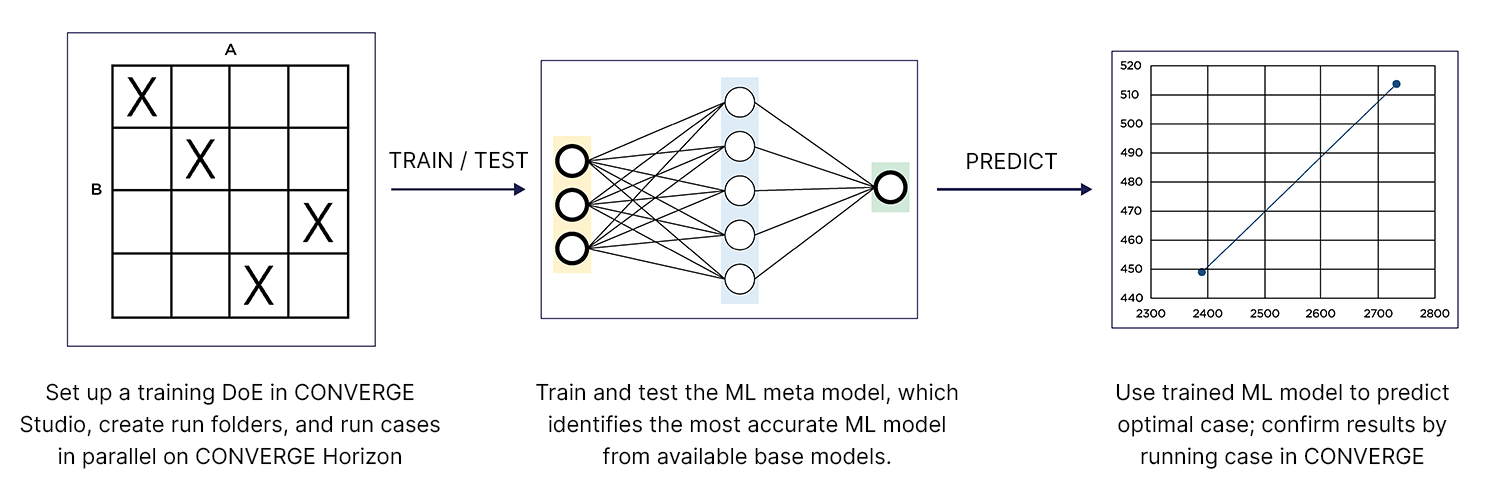
First, users identify the variables to optimize, called the design parameters, and the performance metrics, called response variables, used to assess the merit of the simulation results. Next, the tool automatically generates a design of experiments (DoE) study using quasi-random combinations of the design parameters, employing a Latin hypercube sampling approach to capture the underlying data distribution.1 This approach ensures that the design space is sufficiently explored without an exhaustive search. Once each case setup is generated, users can run their simulations on our high-performance cloud computing platform, CONVERGE Horizon, or on their hardware of choice. Unlike in a GA optimization, these cases can be run concurrently, meaning that with sufficient computing resources, the whole DoE can be completed in the time it takes to run a single simulation. Once completed, these simulations serve as training data for the ML model in CONVERGE. Alternatively, users can train the model on experimental data, if available, enabling ML-assisted optimization without an initial DoE.
Once trained, the model can predict the relationship between the design variables and the corresponding response variables at any point within the design space. It does so using a meta model, an algorithm that blends the outputs of multiple ML models to give the best possible answer.
Finally, the CONVERGE ML tool predicts the setup that optimizes the response variables, which users can then simulate to confirm the results. The complete process is shown in the diagram in Figure 1.
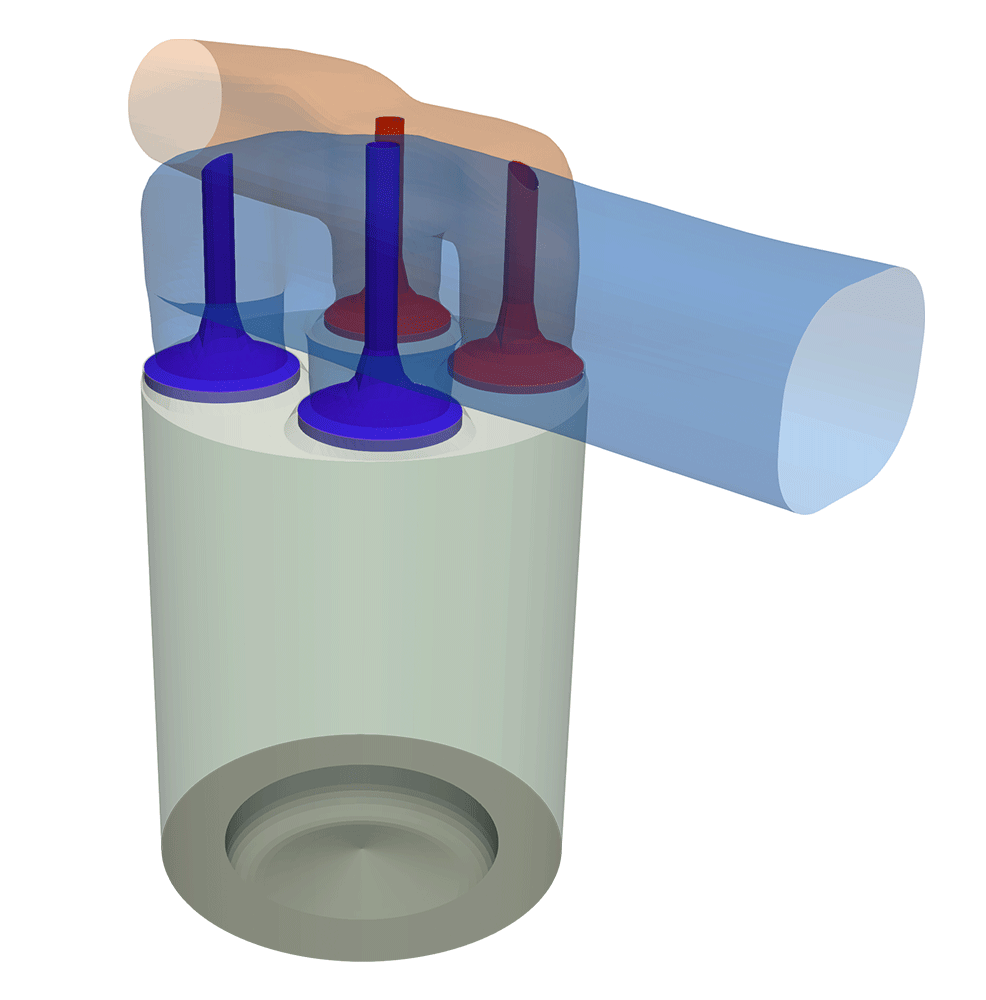
Our engineers began with an experimentally validated setup of a Caterpillar 3400 engine,2 referred to as the baseline case. They studied three design inputs: start of injection (SOI), injection duration (DOI), and nozzle spray angle (NSA). The response to each change was quantified by its impact on three response variables: soot, indicated specific fuel consumption (ISFC), and NOx, with a weighted merit function reflective of the optimization priorities. This resulted in a DoE simulation space of 100 cases, which were run concurrently on CONVERGE Horizon and completed in less than a day.
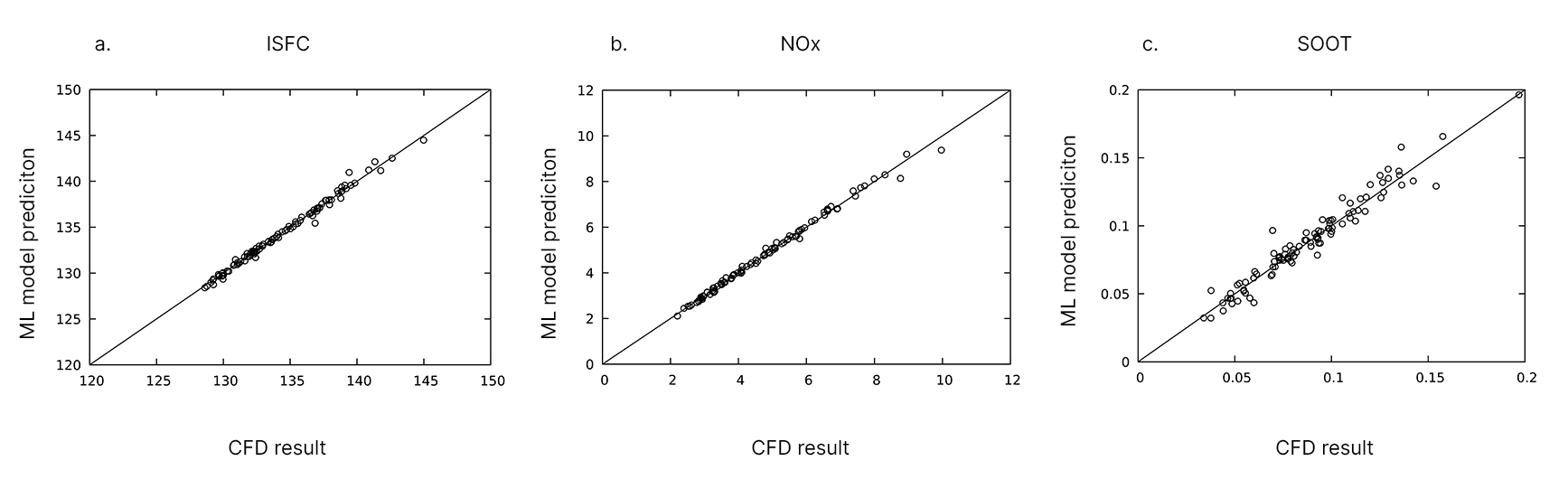
To verify the ML model’s reliability, its predictions were compared against a set of simulation cases that were intentionally excluded from the DoE. This provided a measure of the model’s accuracy and general performance. Afterwards, the cases were incorporated into the training dataset, enabling the model to learn from the additional cases.
Figure 2 shows the comparison between the emissions predicted by the ML model along the y-axis and the CFD simulations along the x-axis. The diagonal of each graph is the line y = x, with any point lying on the diagonal representing a mathematical equality between the ML prediction and the corresponding CFD simulation. As we can see, the points cluster along the diagonal of the graph, implying that the ML model implemented here accurately predicts the results of a given setup.
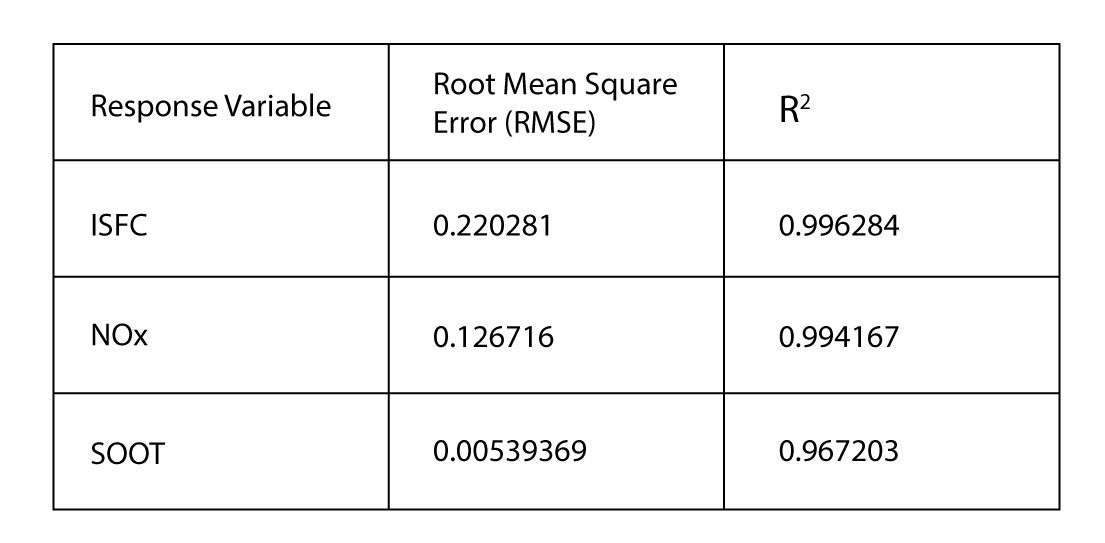
A summary of the statistical analysis is shown in Table 1. Every prediction achieved an R2 value greater than 0.95, indicating that the model can explain over 95% of the variation in CFD results based on any given setup. This level of accuracy is particularly important as the merit function at each point is not predicted by the ML model. Instead, it is calculated from the predicted values of the response variables. Thus, any error in these predictions is carried forward in the calculation. The strong agreement between the CFD and ML model provides confidence that the optimization is based on reliable predictions instead of statistical noise.
With the fidelity of the model confirmed to be good, the next challenge was identifying the optimal conditions. Using the DiRECT optimization algorithm,3 the ML model searched the design space for the engine configuration that maximized the merit function. Each configuration can be evaluated using the ML model in milliseconds, effectively enabling the 5,000-iteration optimization to be completed in less than a minute.
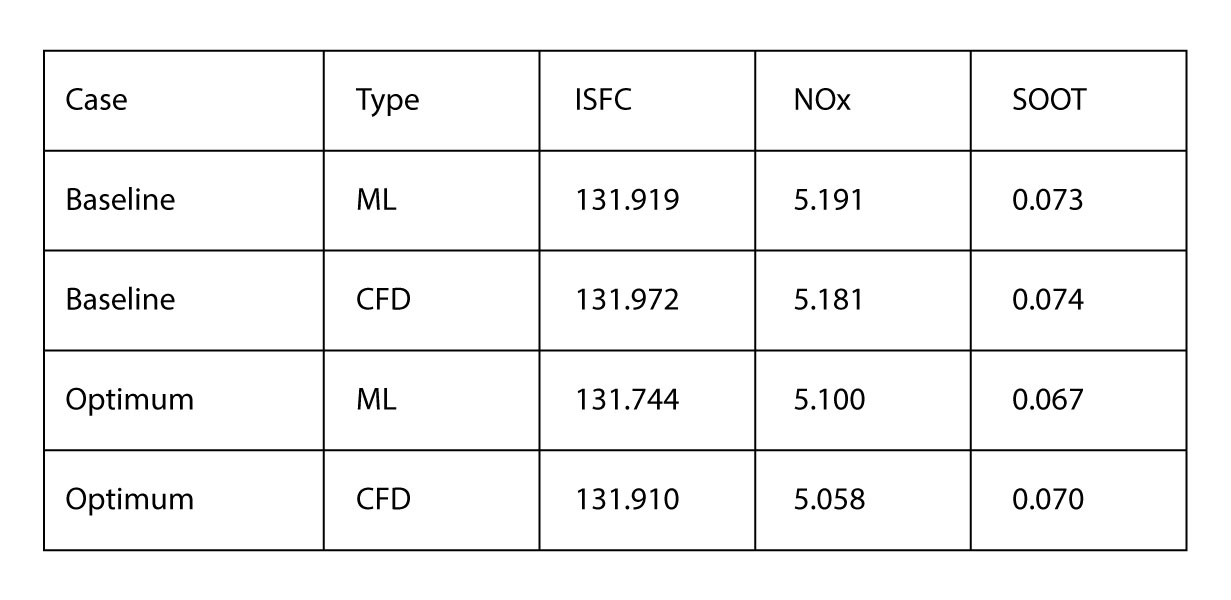
Once identified, a CFD simulation was performed to validate the optimal design. The emissions predicted using the ML model and CFD for the baseline and optimal cases are listed in Table 2, demonstrating good agreement. The optimum design shows improvements in fuel efficiency while simultaneously reducing NOx and soot emissions, confirming that the algorithm was successful in identifying a better performing engine configuration.
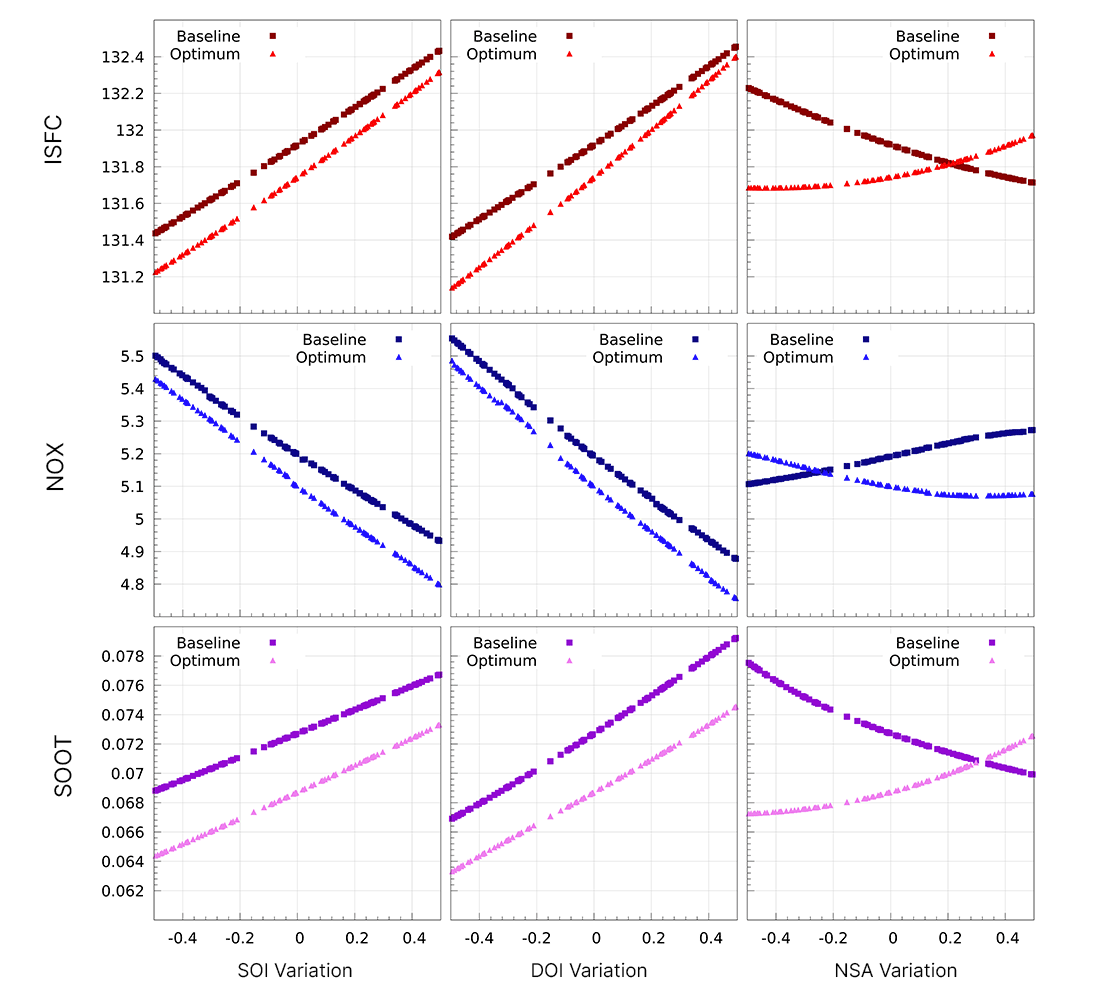
That being said, predicting an optimum is only part of the solution. Any design must also be effective in the real world, where small variations, such as those due to manufacturing tolerances, may affect performance. To evaluate the robustness of the optimized engine, the ML model was also used to investigate how small perturbations in the design parameters affected the predicted engine responses. The results of this investigation are shown in Figure 3. The first two columns show the variations in SOI and DOI, respectively, with similar trends observed in both the baseline and optimized setups, though the optimized design has a slightly steeper response, suggesting that it is more sensitive to changes in the design variables. More importantly, the optimized case is consistently lower in all the measured responses.
The third column in Figure 3, variations in NSA, shows a very different behavior, however. Here, both designs lie near an inflection point in responses, though the variations are in opposite directions. For the baseline setup, increasing NSA decreases ISFC and soot while increasing NOx. In contrast, the optimized setup shows the opposite trend. Nonetheless, in every case, the optimum is closer to the inflection point in each response, resulting in slightly better overall stability against NSA variations.
Interpreting the results of the optimization study, our engineers identified an improved design for Caterpillar 3400 that reduced NOx and soot emissions while improving fuel efficiency. Additionally, by evaluating the response of the optimized design to small perturbations in the three input parameters, they assessed the design’s robustness and sensitivity to real-world variations (such as manufacturing tolerances). All of this in a fraction of the computational time required by conventional optimization approaches!
Interpreting the results of the optimization study, our engineers identified an improved design for Caterpillar 3400 that reduced NOx and soot emissions while improving fuel efficiency. Additionally, by evaluating the response of the optimized design to small perturbations in the three input parameters, they assessed the design’s robustness and sensitivity to real-world variations (such as manufacturing tolerances). All of this in a fraction of the computational time required by conventional optimization approaches!
CONVERGE accurately captures combustion, spray, and emissions physics, providing the high-fidelity data needed to train machine learning models for reliable optimization.
Instead of iteratively running multi-hour CFD simulations to evaluate whether the selected conditions are optimal, the ML model is trained on CFD data (or experimental data) and then used to predict the engine performance for multiple configurations in less than a minute.
Every response variable in this study (ISFC, NOx, soot) achieved an R² above 0.95, indicating that the CONVERGE ML model explained over 95% of the variation in the CFD results.
Yes. CONVERGE’s ML-assisted optimization can be applied to a wide range of CFD applications, including engines, wind farms, and other complex engineering systems.
[1] Stein, Michael L. “Large sample properties of simulations using latin hypercube sampling.” Technometrics Vol. 29 No. 2 (1987): pp. 143–151. DOI 10.2307/1269769.
[2] Montgomery,D.T. “An Investigation of the Effects of Injection and EGR Parameters on the Emissions and Performance of Heavy Duty Diesel Engines.” M.S. thesis, University of Wisconsin-Madison, Madison, WI, USA. 1996.
[3] Jones, Donald R., Perttunen, Carl D. and Stuckman, Bruce E. “Lipschitzian Optimization Without the Lipschitz Constant.” Journal of Optimization Theory and Applications Vol. 79 No. 1 (1993): pp. 157–181. DOI 10.1007/BF00941812.


