

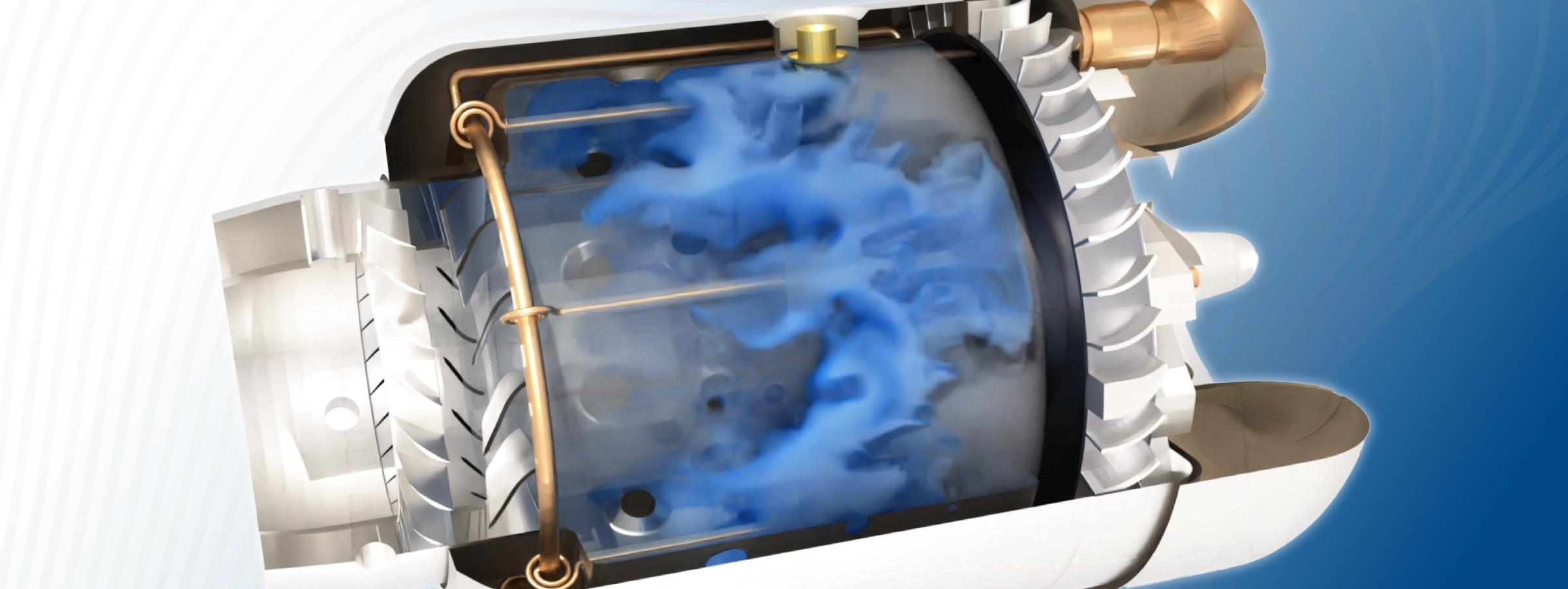
CONVERGE is a leading computational fluid dynamics (CFD) software package with an emphasis on accuracy, efficiency, and innovation. With truly autonomous meshing, state-of-the-art physical models, and the ability to easily accommodate complex moving geometries, CONVERGE is fully equipped to help you solve the hard problems.
Innovative Meshing
CONVERGE features fully autonomous meshing, which eliminates all user meshing time from the simulation process. In addition, CONVERGE’s novel cut-cell approach perfectly represents your geometry—no matter how complex—and easily accommodates moving boundaries. This approach avoids the numerical viscosity generated by deforming meshes and offers accurate results without intensive hands-on setup. Moreover, Adaptive Mesh Refinement allows you to efficiently achieve the best solution possible for a given computational expense by adding cells when and where they are needed to resolve key flow phenomena.
Capture Essential Physical Processes
Going beyond a visually appealing simulation to obtaining useful, realistic results requires accurate physical modeling. CONVERGE contains an extensive suite of well-validated physical models for simulating everything from fluid-structure interaction and conjugate heat transfer to spray and combustion. In addition, CONVERGE includes the SAGE detailed chemistry solver, which is fully coupled with the flow solver for maximum accuracy and efficiency. If you’re interested in implementing a custom model, you can easily do so through user defined functions (UDFs) to customize CONVERGE to meet your needs.
Accelerate R&D
CONVERGE is designed to simplify and expedite the research and design process for an expansive range of applications, from gas turbine engines to mechanical heart valves. With CONVERGE, you can perform a comprehensive system analysis and optimization to find the best design before building an expensive physical prototype. Since 3D CFD simulations can require long runtimes, CONVERGE enables highly parallel simulations on many processors and demonstrates excellent scaling even on thousands of cores. Taking advantage of these capabilities can drastically reduce time-to-solution for your simulations. Overall, incorporating CONVERGE into your R&D workflow can reduce costs across the board and enable you to bring your product to market sooner.
What’s New in CONVERGE 6?
CONVERGE 6 is the latest release of our CFD software, with a focus on incorporating automation to simplify user workflows, improving simulation efficiency, and extending our modeling capabilities to capture more complex physics.
Major Changes
AI Agents in CONVERGE Studio
CONVERGE 6 adds the capability for AI agents to perform tasks in CONVERGE Studio. With this feature, you can activate a Model Context Protocol (MCP) server that enables AI models (e.g., Claude, Codex, Gemini) to interact with CONVERGE Studio. To turn the AI models into capable agents, we have developed a set of downloadable skills that instruct the models on how to use CONVERGE Studio. These skills cover a range of basic pre- and post-processing operations, such as opening and modifying example cases, turning on different models, and plotting specific variables. More skills will be added as development continues, and you can also develop your own skills tailored to your individual workflows.
Enhanced GPU Solver
CONVERGE 5 introduced a preliminary GPU solver that enabled users to run a limited scope of cases on GPU architectures. In CONVERGE 6, the GPU solver has been upgraded with an expanded set of capabilities, allowing users to simulate a greater range of real-world problems. The GPU solver in version 6 allows for multi-GPU simulations and can handle cases with compressible and incompressible flows, RANS and LES turbulence modeling, and detailed chemistry for combustion modeling. The detailed chemistry solver is adapted from the Zero-RK solver developed by Lawrence Livermore National Laboratory. CONVERGE 6 includes several example cases that you can run right out of the box with the new GPU solver, including a DrivAer car case for external aerodynamics, compressible flow over an airfoil, and the Sandia Flame D burner case.
Steady-State Solver Improvements
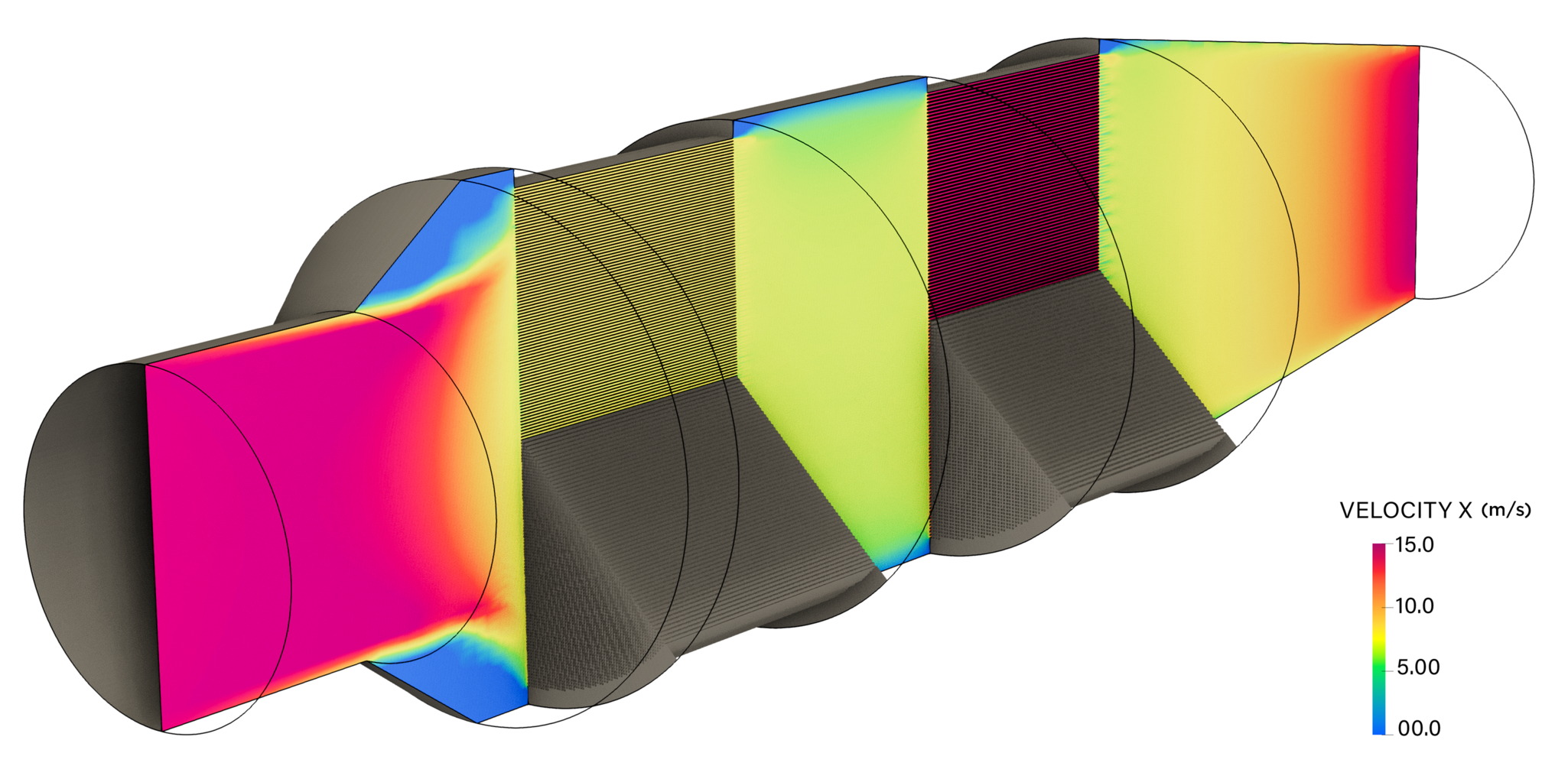
The Under-Relaxation Steady (URS) solver, introduced in CONVERGE 4, continues to be upgraded in CONVERGE 6. Instead of using time marching to reach steady state, as the pseudo-transient solver does, the URS solver uses under-relaxation in place of the transient term. With this scheme, the residuals often converge much faster, significantly reducing runtime. In CONVERGE 6, the URS solver has continued to be improved to achieve faster convergence. In addition, the URS solver has been enhanced to work well for steady combustion cases using the SAGE, EDM, and FGM combustion models. The improvements to the URS solver open the door to highly efficient simulations of industrial burners, flares, and gas turbines.
Automatic Mechanism Reduction
Reducing and tuning a chemical reaction mechanism for use in a CFD simulation can be a multi-step process, requiring several rounds of reduction and tuning to obtain a mechanism that is sufficiently small and accurate. The Automatic Reaction Reduction and Optimization Workflow (ARROW) tool in CONVERGE 6 automates this process for you. The ARROW tool allows you to run several consecutive reductions in a row, optionally including a tuning step after each reduction or after all reductions are complete to optimize the mechanism for your case. CONVERGE 6 also includes the latest version of the detailed C3 mechanism, C3MechV4.0.1, so you can easily extract the fuel chemistry of interest and automatically generate a reduced mechanism all in one program. CONVERGE’s chemistry tools simplify and accelerate your workflow for combustion cases across industries.
Upgraded 1D Solver
Introduced in CONVERGE 5, the 1D flow solver is a reduced-order technique to simulate velocity, pressure drop, and heat transfer throughout a pipe system. CONVERGE 6 expands the capabilities of the 1D flow solver to include turbines, compressors, and junctions. The expanded solver can handle more complex system-level simulations, for example, a turbocharged engine, with the turbocharger and pipes modeled in 1D and the engine cylinder modeled in 3D. For these types of systems, the 1D flow solver dramatically reduces the computational cost of the simulation.
Improvements by Industry
Internal Combustion Engines
CONVERGE 6 offers an array of new and enhanced features for internal combustion engine (ICE) simulations. With the new ability to enable AI agents to interact with CONVERGE Studio, we have developed a variety of skills to help the agents perform common operations for ICE cases, such as changing the compression ratio, updating diesel start-of-injection timing, and modifying valve opening/closing times. We have also added support for variables in input files, which allows you to automatically update related parameters when you modify one variable—for example, automatically updating your mesh embedding and AMR settings when you change your start-of-injection timing.
To facilitate the generation of an optimized chemical reaction mechanism for your ICE simulations, we have added the Automatic Reaction Reduction and Optimization Workflow (ARROW) tool in CONVERGE 6. This tool automates the process of reducing and tuning a reaction mechanism using 0D and 1D targets, saving you time and effort on your chemistry preparation.
CONVERGE 6 also includes new and improved methods for modeling fuel injectors. The Eulerian-Lagrangian Spray Atomization (ELSA) model has been upgraded to accommodate multiple liquid species. In addition, we have implemented an efficient new method to transition from volume of fluid modeling to Lagrangian parcel modeling, useful for speeding up injector simulations including internal nozzle flows. A new tabulated detailed soot model offers significant speedup for soot predictions, and a new condensation model for wall films can provide insight into the condensation of alternative fuels like methanol and ethanol.
Gas Turbines
Improvements to CONVERGE’s gas turbine modeling capabilities in version 6 focus on acceleration, automation, and optimization. The new Automatic Reaction Reduction and Optimization Workflow (ARROW) tool automates the process of reducing and tuning your chemical reaction mechanism, helping to streamline your pre-simulation workflow. When running your case, you can use the improved Under-Relaxation Steady (URS) solver with the SAGE, FGM, and EDM combustion models to significantly accelerate your simulation. Version 6 also includes a method to initialize combustion simulations quickly by allowing you to switch from EDM to SAGE on the fly during your simulation. With this feature, you can obtain accurate predictions of emissions, conjugate heat transfer (CHT), radiation, and other complex phenomena at a lower computational cost. For CHT cases, a new feature has been added to automatically detect CHT interfaces, which simplifies your case setup procedure. In addition, you can now apply different base grids to different streams, enabling you to optimize your meshing strategy for both the fluid and solid streams during CHT simulations.
Burners
The improved Under-Relaxation Steady (URS) solver in CONVERGE 6 offers a significant advantage for steady-state burner simulations. Because burners are designed to run under stable operating conditions, steady-state simulations can provide meaningful results with a quick turnaround time. In CONVERGE 6, the URS solver can be used in conjunction with a variety of combustion models, including SAGE, FGM, and EDM, facilitating highly efficient burner simulations. CONVERGE 6 also includes a method to initialize combustion simulations quickly by allowing you to switch from EDM to SAGE on the fly during your simulation. With this feature, you can run a fast steady-state simulation using EDM to reach a steady solution, then switch to SAGE detailed chemistry to obtain accurate predictions of burner emissions, flame shape, radiation, and other complex phenomena.
Exhaust Aftertreatment
CONVERGE 6 includes a variety of enhancements for exhaust aftertreatment system modeling. A new capability to apply an energy source directly to the solid phase of a porous region simplifies and accelerates simulations of exhaust gas heat-up crossing an electrical heated catalyst (EHC). Urea deposit decomposition in the deposit growth model has been improved when the deposit buildup thickness is high. For ammonia uniformity simulations, the instantaneous evaporation of splashed parcels was developed to enhance urea conversion and ammonia mixture with exhaust gas. The addition of a VOF-Lagrangian parcel transition model also allows for more realistic predictions of primary diesel exhaust fluid (DEF) spray breakup in urea/SCR systems. Furthermore, we have enhanced our surface deformation prediction capabilities, which will help users predict urea deposit buildup more accurately and increase simulation stability if the buildup is substantial.
Batteries & Electric Motors
CONVERGE 6 features several improvements that significantly speed up conjugate heat transfer (CHT) simulations of battery packs and electric motors with many coupled interface boundaries. Additionally, version 6 adds the capability to apply different base grids to different streams, enabling you to employ an optimized meshing strategy for both the fluid and solid streams in CHT simulations.
Fuel Cells
A variety of new models and features for modeling PEM fuel cells have been added in CONVERGE 6. A new dissolved water transport model allows for more accurate calculations of ionic conductivity, and we have added new fuel cell outputs, implemented current boundary conditions, and enabled the automatic calculation of the cell equilibrium potential. In version 6, users also have greater control over several fuel cell features, allowing you to specify your own correlations for dissolved water content and ionic conductivity and allowing for custom versions of the Butler-Volmer source terms. These enhancements enable a wider range of fuel cell types to be modeled in CONVERGE.
Energy & Marine Applications
CONVERGE 6 includes several updates that are beneficial for simulations of energy and marine technologies. Version 6 offers improved stability for non-Newtonian flows, which are common in nuclear plants and various oil and gas applications. In addition, bubble parcels are now supported in version 6, enabling more realistic simulations of steam in nuclear power plants. Turning to the offshore sector, CONVERGE 6 includes a new VOF-Lagrangian parcel transition model, which is useful for assessing breaking wave loads on offshore structures. The new version offers enhanced stability for marine simulations, including offshore wind turbines, drilling platforms, and boat hulls. Finally, the solidification and melting model has been improved in version 6, allowing for more accurate simulations of wax deposition in pipelines, hydrate formation, and pipeline restart after shutdown.
Pumps & Compressors
Designing pumps and extruders to handle non-Newtonian fluids is important for manufacturing, oil and gas, and sewage applications, among many others. In CONVERGE 6, the solver stability has been improved for cases with non-Newtonian fluids at high solid viscosity. CONVERGE 6 also features a model for multi-component, multi-phase vaporization that allows you to capture more complex physics when dealing with mixtures, such as in multi-component refrigeration systems, liquified petroleum gas (LPG) tanks, and heat exchangers. Additionally, CONVERGE’s 1D flow solver has been upgraded to include turbines and compressors, offering a rapid method for obtaining inlet and outlet conditions for these devices. With this enhancement, you can accelerate system-level simulations for a range of applications, including HVAC, pipeline, and power generation systems.
Biomedical
CONVERGE 6 features several new and enhanced models for improved cardiovascular simulations. Because the density of biological tissue is similar to the density of blood, implicit fluid-structure interaction (FSI) modeling is critical for achieving stable simulations of blood vessels. CONVERGE 6 introduces the Interface Quasi-Newton (IQN) method, a new implementation of the implicit coupling calculations. Compared to the Aitken’s method, which is available in previous versions of CONVERGE, the IQN method offers significant speedup and increased solver stability for biomedical simulations using implicit FSI modeling.
CONVERGE 6 also extends the three-element Windkessel model to a four-element model, accounting for inductance as well as capacitance and resistance. The four-element Windkessel model better mimics the behavior of downstream vascular networks, providing more accurate boundary conditions for simulations of blood vessel segments. Finally, CONVERGE 6 includes a preliminary feature for calculating residence time using an Eulerian method. This feature predicts pockets of stationary or slow moving fluid in the cardiovascular system that could increase the risk of clot formation.
Rockets
In version 6, CONVERGE’s rocket modeling capabilities have been enhanced for greater efficiency, improved mixing and combustion models, and upgraded meshing capabilities.
CONVERGE 6 introduces significant improvements in solver stability and accuracy for simulating flows under transcritical conditions. It features more accurate pressure-density coupling, a more robust energy solver, and expanded capabilities for modeling phase-change phenomena. These include an improved multi-root equation of state (EOS) with a liquid-vapor non-equilibrium assumption, as well as dynamically tabulated real-fluid models (RFM) based on a liquid-vapor equilibrium assumption. Together, these enhancements enable more accurate predictions of real-fluid mixing physics near critical conditions, making them particularly important for liquid rocket combustion simulations. In addition, the upgraded Under-Relaxation Steady (URS) solver in CONVERGE 6 significantly accelerates simulations of steady-state ideal-gas combustion cases.
Additional improvements have been made for combustion modeling with non-ideal gas EOS, including enhancements to the Flamelet Generated Manifold (FGM) model and the addition of a constant enthalpy pressure option for the chemical equilibrium (CEQ) models. For simulations of rocket fuel blends, a multi-component, multi-phase vaporization model has been added, and the Eulerian-Lagrangian Spray Atomization (ELSA) model has been extended to handle multiple liquid species.
For meshing, CONVERGE’s Adaptive Mesh Refinement (AMR) feature has been enhanced in version 6 to better handle large density gradients, commonly found in rocket simulations. Furthermore, AMR is now available for inlaid meshes, which is useful for resolving boundary layers to more efficiently capture external aerodynamics.
Looking for Converge 5?
Click here for information on the models and features introduced in CONVERGE 5.


