Benefits
Events
Products & Programs



Author:
Allie Yuxin Lin
Marketing Writer
As the world pushes to combat the negative effects of climate change and reduce carbon emissions, the automotive and energy industries have turned their attention to innovative alternatives. The global search for sustainable and environmentally friendly energy solutions has paved the way for the rise of hydrogen-powered internal combustion engines (H2 ICEs). Hydrogen is an energy carrier that can be produced from renewable energy sources such as solar and wind. It can be used in “fuel-agnostic” engines, which have a shared base engine design, making them capable of running on multiple fuels. Additionally, hydrogen can readily be used in modern ICEs without changing the powertrain technology. While ICEs running on traditional fuels may experience engine knock, which occurs when fuel burns unevenly and results in equipment damage, H2 ICEs have a reduced knock tendency due to hydrogen’s faster flamespeeds and higher octane number. H2 ICEs, with their potential to decarbonize the transportation industry, offer a realistic path into a more sustainable future.1
Despite the advantages of hydrogen, there are still many obstacles that hinder the widespread adoption of H2 ICEs. CONVERGE, our innovative CFD solver, can overcome these obstacles and provide detailed insights into the complexities of hydrogen modeling. Through our continuous development of CONVERGE, we at Convergent Science are committed to helping our users design sustainable H2 technology solutions.
One of the challenges of port-fueled H2 ICEs is the risk of flame flashback into the intake manifold. Hydrogen’s faster mixing rates and higher flamespeeds make it more prone to flashback, a phenomenon where the flame propagates upstream, potentially causing damage to the engine hardware. To prevent flashback, manufacturers may place a flame arrestor in the intake manifold, which will quench the flame and stop it from spreading upstream to fuel pipes, fuel tanks, or other critical engine components. CONVERGE includes several unique features that make it well-suited for designing flame arrestors for H2 ICEs. Typically, flame arrestors will consist of many narrow channels, which can be easily captured by our autonomous meshing. The flow, combustion, and wall heat transfer within these channels can be simulated with CONVERGE’s turbulence modeling, detailed chemistry solver, and conjugate heat transfer (CHT) modeling capabilities. If the wall temperatures of the arrestor become too hot from repeated backfiring caused by ignition issues or exhaust leaks, the flame arrestor can no longer arrest the flame. CHT modeling can predict how the metal walls gain and lose heat during interactions with intake flow and backfire flames over various engine cycles.
In direct-injection (DI) engines, the injected hydrogen flows into the combustion chamber at sonic or supersonic speeds. Resolving these extreme velocities requires a very fine mesh and small time-steps, which can become computationally expensive. CONVERGE users can accurately resolve the high-speed gas jets with supersonic inflow boundary conditions, the density-based solver, and the total energy solver. Our Adaptive Mesh Refinement (AMR) feature is incredibly valuable for dynamically creating finer meshes at areas of higher velocity gradients to capture key physical phenomena, such as fuel-air mixing and jet penetration. Conversely, AMR can coarsen the mesh in regions of lower velocity gradients, reducing computational memory and runtime. An accurate simulation of hydrogen injection will also need to capture the shock waves and gaseous expansion that results from high-speed injection. CONVERGE’s density-based solver and AMR can be used to capture the shock front with minimal computational expense, and users can specify species-dependent critical conditions on a case-by-case basis for greater simulation accuracy. CONVERGE is proven to be efficient at capturing shock waves in a variety of applications.2-6
Compared to conventional ICE fuels, hydrogen has much higher flamespeeds. Therefore, predicting various combustion-related phenomena such as ignition and turbulent flame propagation for hydrogen fuel becomes even more critical. Resolving these phenomena requires a solver with detailed chemistry, fine computational meshing, and the ability to handle small time-steps. CONVERGE users can accurately simulate such combustion phenomena with features like AMR and different LES turbulence models, including zero-equation, one-equation, and two-equation.
Furthermore, CONVERGE users have access to detailed chemical mechanisms of many different fuel components through the Computational Chemistry Consortium (C3). If you want to find detailed chemistry for hydrogen fuel, you can either extract it directly through CONVERGE Studio from the parent C3 mechanism, or you can search the literature for published mechanisms.
Accurately modeling the binary or mixture-averaged molecular diffusion is necessary for achieving precise mixing rates and flame speeds in H2 ICEs. In CONVERGE, the mixture-averaged diffusion model can be activated to account for preferential species diffusion. This can generate meticulous predictions of hydrogen’s laminar flamespeeds.
At Convergent Science, we are dedicated to ensuring CONVERGE remains at the forefront of CFD technology. We want to make sure we meet the needs of our clients in critical and ever-evolving areas like sustainability. Therefore, our newest version includes several new features that further refine CONVERGE’s capabilities for hydrogen modeling.
For hydrogen, the flame thickness is quite thin, which would require a very fine mesh to resolve. In lieu of using expensive meshing to resolve the turbulent flame front, CONVERGE’s Thickened Flame Model (TFM) can artificially increase the flame thickness without changing the flame propagation speed. In previous versions of CONVERGE, TFM was only available for LES simulations. With the newest release of CONVERGE 4, our software has the ability to use its TFM for RANS simulations, which is far less computationally expensive than LES modeling.

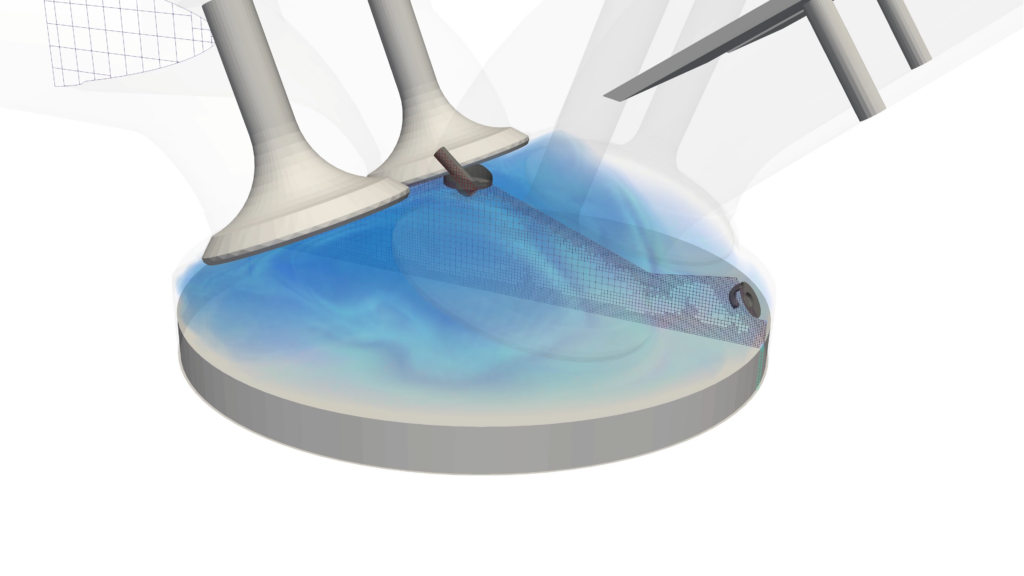
Spark-ignition engines, like gasoline engines, often have high levels of dilution and increased turbulence, which can affect the ignition process, combustion stability, and cycle-to-cycle variation (CCV). To address this, engineers from Argonne National Laboratory and Convergent Science worked together to develop the Lagrangian-Eulerian Spark Ignition (LESI) model.7 Now available in CONVERGE 4, the LESI model is a line-source ignition model that first creates a line of Lagrangian particles. The model then tracks the motion of each particle using a Lagrangian algorithm that relies on a resolved Eulerian velocity field. At the end of each computational time-step, energy is deposited in the Eulerian cells at the location of each Lagrangian particle.8 Hydrogen’s unique properties, including its high flamespeed and high diffusivity, requires a detailed and accurate description of the spark energy, which can be accomplished with the LESI model. The model can also predict ignition timing, flame kernel formation, flame propagation, and combustion stability.
In 1977, Marble and Broadwell first proposed the Coherent Flame Model, which describes turbulent chemical reactions and allows for a separation of the flame structure and the turbulent flow structure. CONVERGE users have access to the Extended Coherent Flame Model (ECFM), which can describe premixed combustion, as well as the 3-Zone Extended Coherent Flame Model (ECFM3Z), which can be used for non-premixed combustion. In previous CONVERGE versions, ECFM and ECFM3Z required fuel species to have both a carbon and hydrogen component, in addition to adhering to the CxHyOz structure, limiting the applicability of the models to traditional hydrocarbon fuels. In CONVERGE 4, the models no longer require fuel species to have a carbon component, and the fuel definition has been expanded to CxHyOzNm. With this change, the model can be used for hydrogen and ammonia fuels, opening the door to a variety of new combustion applications.
Collaborating with influential institutions is another way we maintain our position as leaders in the field of sustainability. By partnering with key industry players and engaging with top research organizations, we’re pushing the boundaries of what’s possible in sustainable development. Our commitment to building strong alliances not only enhances our expertise, but also amplifies our impact on CFD.
In an effort to decarbonize global transportation by investigating hydrogen fuel, we have partnered with Wabtec, Oak Ridge National Laboratory, and Argonne National Laboratory to research the use of hydrogen fuel for the rail industry. Most existing freight locomotives operate on diesel engines, which are undesirable due to their negative environmental impact, such as high CO2 and NOx emissions. With this in mind, the project aims to develop engines that can run either on a combination of hydrogen and diesel or entirely on hydrogen or other alternative fuels. In late 2023, a Wabtec single-cylinder, dual-fuel locomotive engine was installed at Oak Ridge National Laboratory, where researchers have been using it to conduct experimental testing with low-life-cycle carbon fuels. We are working with both Wabtec and Argonne National Laboratory on the CFD side of the project, and our results provide invaluable insights that inform the direction of further experimental testing.
In a second collaborative effort, we recently partnered with Caterpillar and Argonne National Laboratory to develop predictive computational capabilities for the analysis and design of advanced ICEs using carbon-free or reduced-carbon fuels. CONVERGE is being used to analyze and predict the physical processes involved in the engine operation, such as fuel injection, mixing, combustion, and emissions formation. The team has completed high-fidelity LES and RANS simulations of hydrogen port-fuel injection (PFI). While LES results show better mixing performance, they come at a higher computational cost. On the other hand, the RANS simulations were more efficient but significantly underpredicted hydrogen mixing. Future research on this project aims to develop a better RANS mixing model and improve the combustion model to reduce the risk of abnormal combustion events, such as pre-ignition or knock.
CONVERGE includes a variety of solutions to overcome the challenges of hydrogen modeling, and we are committed to continuously improving its capabilities to address even more complex problems. In addition to developing new features, we are also engaging with the academic community to advance innovation in CFD and accelerate the adoption of hydrogen internal combustion engines. Onwards, to a more sustainable future!
[1] Jose, A., Probst, D., and Biware, M., “A Machine Learning Approach for Hydrogen Internal Combustion (H2ICE) Mixture Preparation,” SAE Technical Paper 2024-26-0254, 2024, doi: 10.4271/202-26-0524.
[2] Quan, S., Dai, M., Pomraning, E., Senecal, P.K., Richards, K., Som, S., Skeen, S., Manin, J., and Pickett, L.M., “Numerical Simulations of Supersonic Diesel Spray Injection and the Induced Shock Waves,” SAE Paper 2014-01-1423, 2014. DOI: 10.4271/2014-01-1423.
[3] Li, Y., Liu, B., Wang, M., Liu, G., and Dong, Q., “Experimental and Numerical Investigation of the Shock Wave Induced by a High-Pressure Diesel Spray,” IEEE Access, 9, 70472-70478, 2021. DOI: 10.1109/ACCESS.2021.3077978
[4] Wijeyakulasuriya, S. and Mitra, S., “Analyzing Three-Dimensional Multiple Shock-Flame Interactions in a Constant-Volume Combustion Channel,” Combustion Science and Technology, 186(12), 1907-1927, 2014. DOI: 10.1080/00102202.2014.937860
[5] Attal, N. and Kumar, G., “Deflagration to Detonation Transition in Two-Dimensional Obstructed Channels,” AIAA SciTech 2022 Forum, AIAA 2022-0392, San Diego, CA, United States, Jan 3–7, 2022. DOI: 10.2514/6.2022-0392
[6] Wang, Y., Qi, Y., Xiang, S., Mével, R., and Wang, Z., “Shock Wave and Flame Front Induced Detonation in a Rapid Compression Machine,” Shock Waves, 28, 1109–1116, 2018. DOI: 10.1007/s00193-018-0832-2
[7] Scarcelli, R., Zhang, A., Wallner, T., Som, S., Huang, J., Wijeyakulasuriya, S., Mao, Y., Zhu, X., and Lee, S.-Y., “Development of a Hybrid Lagrangian–Eulerian Model to Describe Spark-Ignition Processes at Engine-Like Turbulent Flow Conditions,” Journal of Engineering for Gas Turbines and Power, 141(9), 2019. DOI: 10.1115/1.4043397
[8] Kazmouz, S.J., Scarcelli, R., Cheng, Z., Dai, M., Pomraning, E., Senecal, P.K., Sjӧberg, M., “Coupling a Lagrangian–Eulerian Spark-Ignition (LESI) Model with LES Combustion Models for Engine Simulations,” Science and Technology for Energy Transition, 77(10), 2022. DOI: 10.2516/stet/2022009


